Particle (Basic ㊦ 267)
A marker that indicates exemplification.
Equivalent: And so on; and the like; for example; things like ~
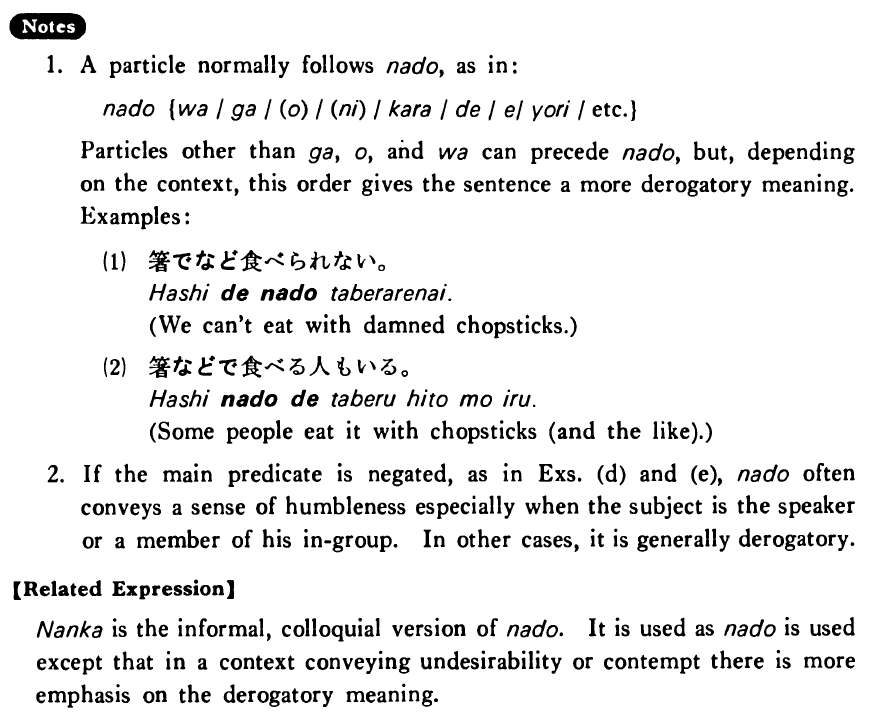
1. A particle normally follows など, as in:
Particles other than が, を, and は can precede など, but, depending on the context, this order gives the sentence a more derogatory meaning. Examples:
If the main predicate is negated, as in Examples (d) and (e), など often conveys a sense of humbleness especially when the subject is the speaker or a member of his in-group. In other cases, it is generally derogatory.
【Related Expression】
なか is the informal, colloquial version of など. It is used as など is used except that in a context conveying undesirability or contempt there is more emphasis on the derogatory meaning.